Service · Atlanta, GA
Sod Repair & Patching in Atlanta
Dog spots, grub damage, fungus patches and utility dig-ups cut out and re-sodded to match your existing lawn, without tearing up grass that is still healthy.
Fixing the damaged section, not the whole lawn
Most lawn damage is not lawn-wide. A dog that runs the same path along the fence, a grub colony that hits one corner of the yard, a fungus outbreak that spreads through a shaded strip, or a utility company that dug a trench across the front yard — these all leave an otherwise healthy lawn with one bad section. Sod repair and patching cuts that section out clean and re-sods it to match the surrounding grass, so you are not paying to redo turf that was never the problem.
If the damage covers most of the yard rather than a section or two, patching stops being the efficient option and full lawn renovation usually costs less in the long run. We will tell you honestly which one your lawn actually needs when we walk it — we are not going to sell a full renovation to a yard that just needs three patches, and we are not going to sell three patches to a yard that is going to keep failing.
Diagnosing the cause before we patch anything
This is the step a lot of patch jobs skip, and it is why so many patches fail again within a season. A dead or thin patch is a symptom, not the problem itself. Laying fresh sod over a grub infestation that has not been treated, a drainage low spot that is still ponding water, or an irrigation dead zone that never gets covered just buys a few weeks before the new sod dies the same way the old grass did. Before we cut out a single section, we look at what actually caused it:
- Grub or insect damage — turf pulls up loose with no root resistance, often with visible larvae in the top inch of soil.
- Fungus — circular or irregular dead patches, usually in shaded or poorly-drained areas, sometimes with a visible ring pattern.
- Irrigation dead zones — a consistent dry patch in the same spot every season points to a sprinkler head that is clogged, misaligned or simply not reaching that section.
- Drainage or grading — a low spot that stays wet and eventually drowns the grass sitting in it.
- Physical damage — dog wear paths, a utility dig-up, a fallen branch, or equipment left on the lawn too long.
Matching grass type and age so the patch does not stand out
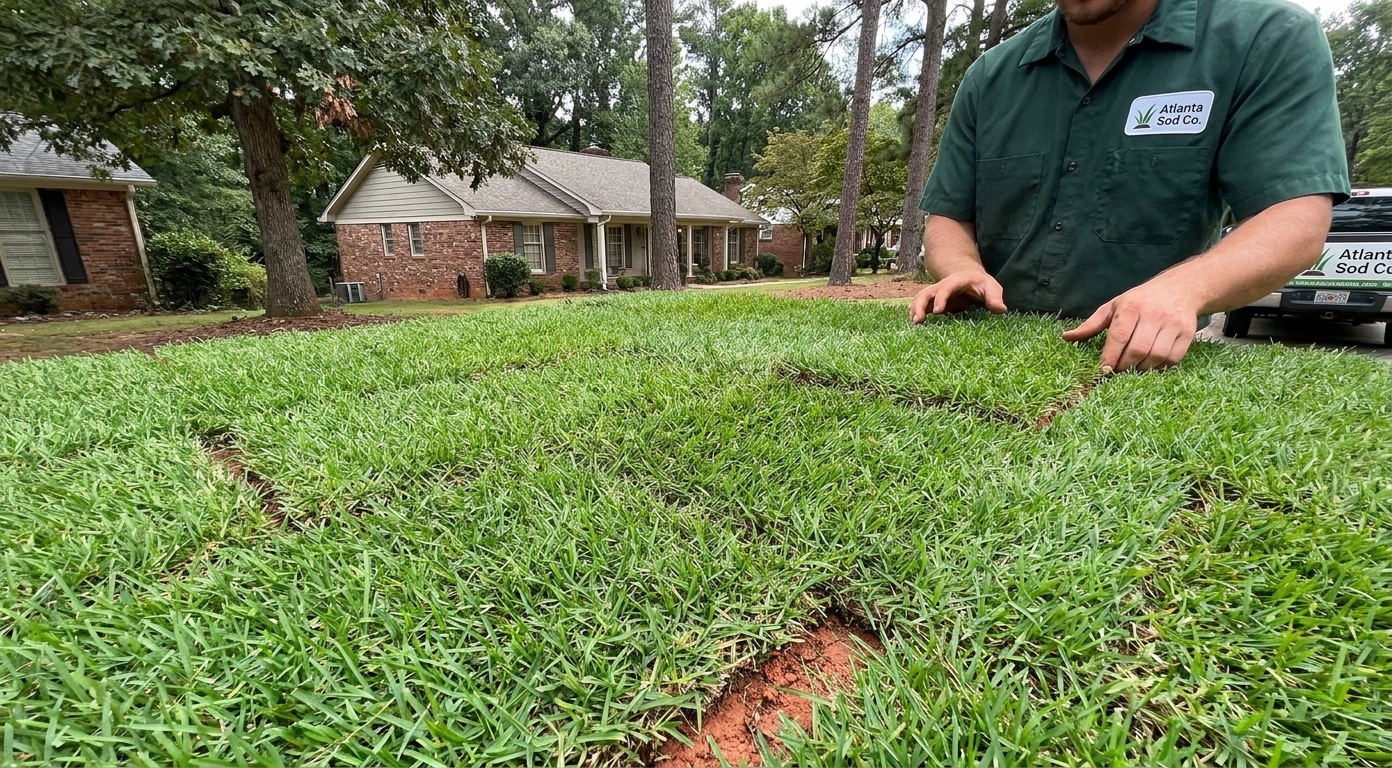
A patch that does not match the surrounding lawn is worse than the dead spot in some ways — now you have a visible mismatched square instead of a dead one. We identify the existing turf type before ordering replacement sod, and match it as closely as possible: Bermuda for Bermuda, Zoysia for Zoysia, Centipede for Centipede. See Bermuda, Zoysia and Centipede sod installation if you are not sure which one is currently in your yard.
Even a correctly matched patch will look slightly different at first because it is younger than the surrounding grass. That gap closes within a season as the new sod knits in and matches color and density with the established lawn around it. It is normal, and it is a much smaller mismatch than leaving a dead brown patch in place.
How a repair visit works
- Walk the damaged area and identify the cause, not just the symptom.
- Address the underlying issue first if one exists — grub treatment, irrigation head adjustment, or a small grading fix.
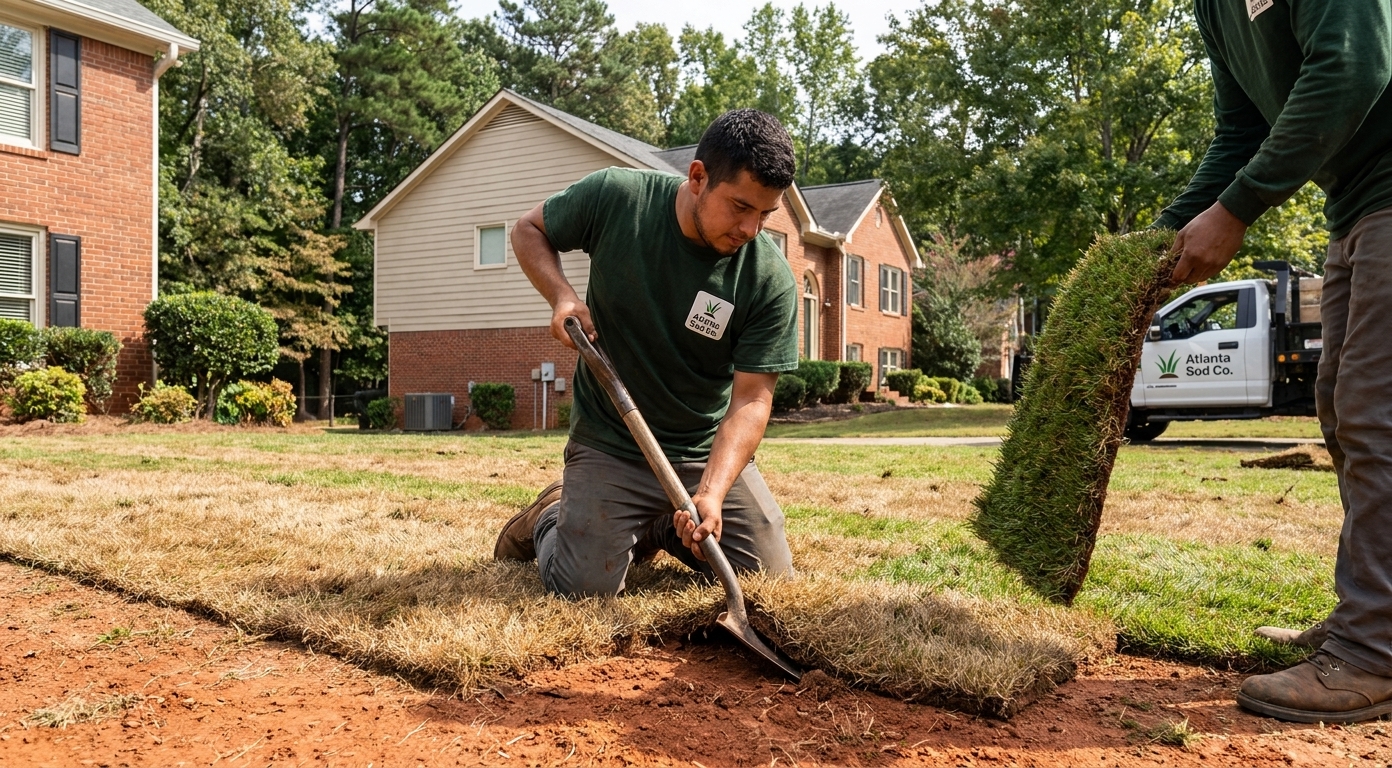
- Cut out the dead or damaged section cleanly along a straight or curved edge.
- Match and install replacement sod, hand-pressed tight against the surrounding turf with no visible seam gap.
- Water-in the patch and give a short watering schedule specific to the smaller repair area.
What sod repair and patching costs
Small jobs carry a minimum trip charge rather than a pure per-square-foot rate, because the labor to diagnose, cut and match a small patch is close to the same whether it is 50 square feet or 300. Once a repair crosses roughly 500 square feet, pricing shifts to a per-square-foot rate similar to a small installation.
| Job | Typical range | What moves the price |
|---|---|---|
| Spot repair, under 500 sq ft | $375 – $650 min | Minimum trip charge applies |
| 500 – 1,500 sq ft | $0.65 – $0.95/sq ft | Area size, turf type, access |
| Diagnostic visit | Often free with repair | Waived when repair is booked |
| Bermuda-matched patch | $0.55 – $0.85/sq ft | Same range as new Bermuda install |
| Zoysia-matched patch | $0.85 – $1.25/sq ft | Same range as new Zoysia install |
| Centipede-matched patch | $0.60 – $0.90/sq ft | Same range as new Centipede install |
When patching is not the right call
If a yard has been patched more than once in the same spot, or the damage covers more than roughly a third of the total lawn, we will say so rather than sell another patch that is likely to fail again. At that point full lawn renovation — stripping the lawn, correcting grading and drainage, and resodding the whole yard — usually ends up cheaper than a third or fourth round of patching the same underlying problem.
Watering a patch versus watering a whole new lawn
A small patch actually needs more careful attention than a full install in one respect: it is easy to water the established lawn around it on a normal schedule and forget that the new section needs the same twice-daily soak a brand-new install would get for its first week to ten days. We mark the patch area clearly and walk you through exactly how to water just that section without over-watering the surrounding established grass, since the two areas are on different clocks for the first couple of weeks.
Preventing the next patch
Once we have identified and fixed the cause behind a dead spot, it is worth a quick look at whether the same issue could be developing elsewhere in the yard. A grub problem rarely stays contained to one corner forever, and an irrigation system old enough to have one dead zone often has a second one that has not shown up yet simply because the grass there has not died as visibly. We will flag anything else worth watching while we are already on site, at no extra charge, rather than come back for a second trip charge next season.
Warranty on repairs
Patch work carries the same one-year sod establishment warranty as a full install, covering sod that fails to root due to installation error. It does not cover a patch that fails because the original cause — grubs, drainage, an irrigation dead zone — was not addressed or was left untreated by the homeowner after we flagged it.
Where we repair and patch sod
We handle sod repair and patching throughout metro Atlanta, including Decatur, Sandy Springs, Roswell, Alpharetta, Marietta, Smyrna, Dunwoody and Kennesaw. If the damage is more widespread than a patch or two, see full lawn renovation first.
Questions
Sod Repair & Patching FAQs
Small patches under 500 square feet carry a $375 to $650 minimum trip charge, since the labor to diagnose and match a small area does not scale down much below that. Repairs between 500 and 1,500 square feet run $0.65 to $0.95 per square foot instead. We give a flat price after seeing the area, not a phone quote.
We match grass type — Bermuda, Zoysia or Centipede — as closely as possible to what is already growing. A brand-new patch looks slightly younger at first, but that gap closes within a season as it knits in and matches color and density with the established lawn around it.
Yes, and this is the step that determines whether the patch actually holds. Grub damage, fungus, an irrigation dead zone or a drainage problem all need to be identified and, where possible, addressed before we patch. Otherwise the new sod tends to fail the same way the old grass did.
Usually, if you book the repair at the same time. The diagnostic walkthrough is included in the repair price. If you only want the cause identified without committing to a repair, we can quote that as a standalone visit.
There is no hard minimum, but smaller jobs carry a flat trip-charge-style minimum of $375 to $650 rather than a per-square-foot rate, since the labor to show up, diagnose and cut in a small patch is close to the same regardless of size.
If the damage is limited to one or two sections and the rest of the lawn is healthy, patching is the right, cheaper fix. If more than about a third of the yard is dead, thinning or has failed to hold turf repeatedly, full lawn renovation usually saves money over patching the same spot again and again.
We can, but we will diagnose it more carefully first, because a spot that fails twice almost always has an unresolved cause — usually irrigation coverage or drainage. If we cannot fix the underlying issue this time, we will tell you honestly rather than take payment for a patch likely to fail a third time.
Yes, patch work carries our standard one-year sod establishment warranty for installation-related failure. It does not cover a repeat failure caused by an untreated grub infestation, drainage problem or irrigation dead zone that was flagged and not addressed.
Most spot repairs are a same-day job once scheduled — cut out the damaged section, install matching sod, water it in. Larger repair areas over 1,500 square feet or jobs requiring drainage correction first can take longer.
Related
Other sod work we do
Get a price for your sod repair
Free walkthrough to diagnose the cause and a flat written price before we cut anything. Most spot repairs are done the same day.
Mon–Sat 7:00am–7:00pm · Licensed & insured · Serving Atlanta and metro Atlanta